
Few pairs of words cause as much trouble as affect and effect. They sound almost identical, they are spelt almost identically, and they even turn up in the same sentences — so it is no surprise that even confident writers pause before choosing one. The good news is that the difference between affect and effect is simple once you see it clearly, and this guide will make sure you never mix them up again.
In the next few minutes, you will learn exactly what each word means, see affect vs effect examples in real sentences, pick up a memory trick that works every time, and test yourself with a short practice quiz. By the end, choosing the right word will feel natural — whether you are writing an essay, an email at work, or a post online.
What Does Affect Mean?
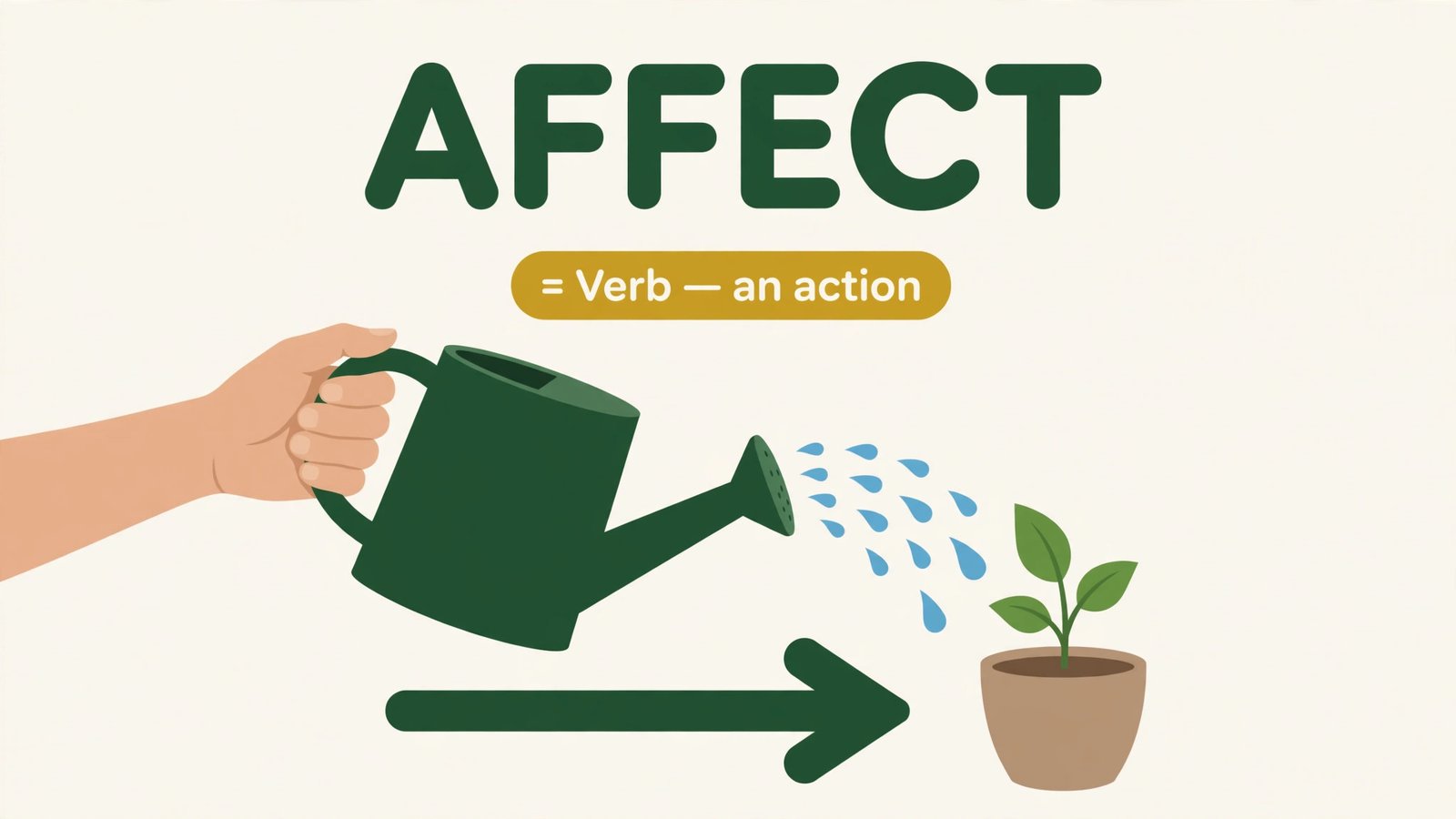
Affect is almost always a verb. It means to influence something, to change it, or to have an impact on it. When you use affect, something is doing something to something else. That is the whole secret: if there is an action happening, the word you want is almost certainly affect.
Think of it this way: rain affects your plans. The rain is doing something — it is changing your plans. The cold affects your mood. The new timetable affects every student in the school. In each case, affect is the doing word, the verb in the sentence.
Here is how the verb changes with tense:
- Base form — affect: “The news will affect us all.”
- Third person — affects: “The weather affects my sleep.”
- Past — affected: “The strike affected thousands of travellers.”
- -ing form — affecting: “The drought is affecting farmers across the region.”
Affect changes its form with tense, like any verb. If tenses still trip you up, our guide to the Present Perfect vs Past Simple explains the patterns clearly.
So when to use affect? Ask yourself a simple question: can I replace this word with “influence”? If the answer is yes, use affect. “The film influenced the audience” becomes “The film affected the audience.” If the sentence still makes sense, you have the right word.
Affect appears in everyday speech far more often than people realise. “How will the price rise affect your budget?” “Loud music affects my concentration.” “Her words affected him deeply.” In every example, something is acting on something else — and that action is the clue.
Affect can also describe feelings. “She was visibly affected by the news” means the news moved her emotionally. That is still the same verb — to influence — just applied to feelings rather than plans or objects.
What Does Effect Mean?
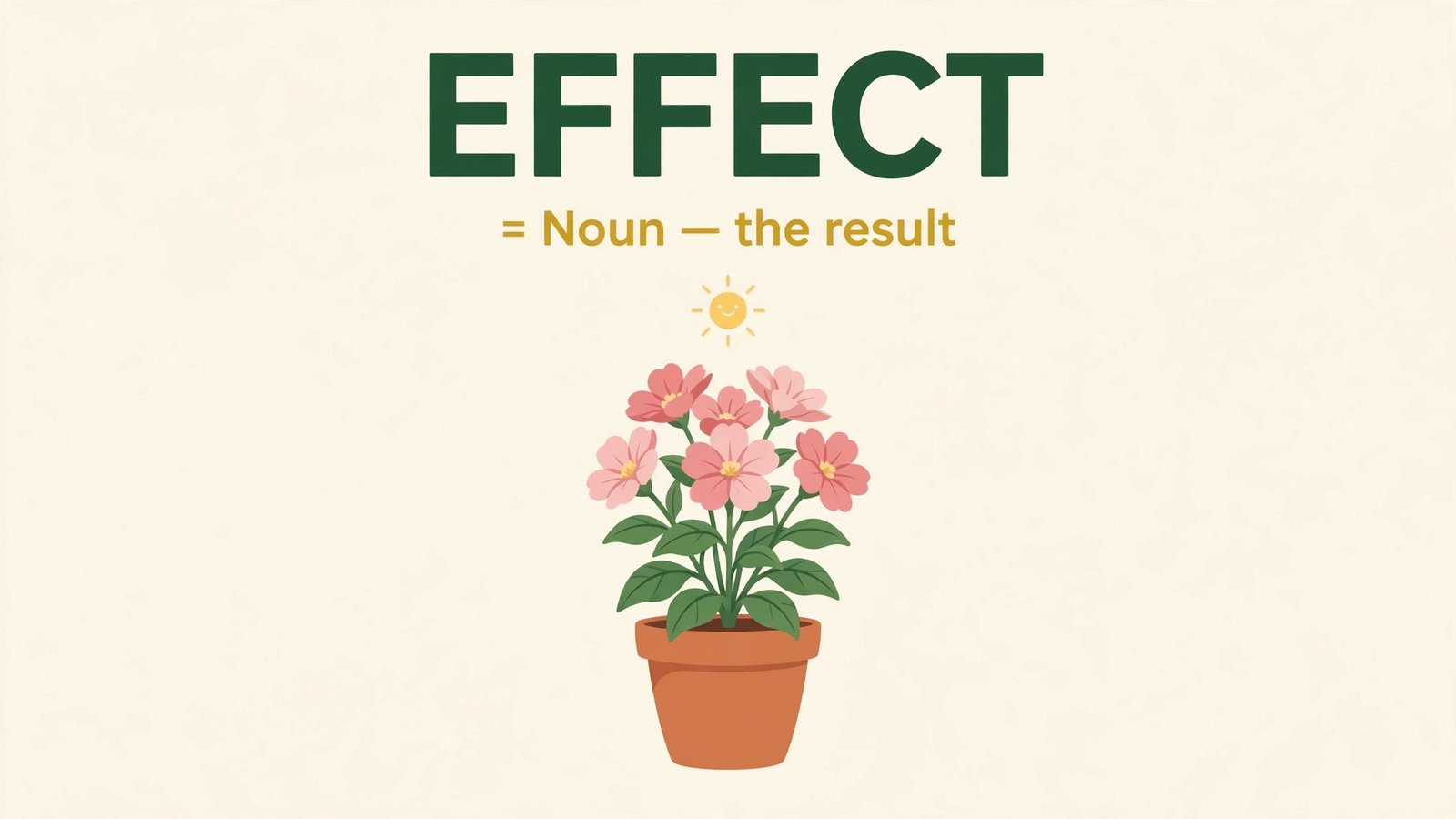
Effect is almost always a noun. It means the result of something — the change that happens because something else happened first. If affect is the action, effect is the outcome.
A simple way to remember it is the phrase cause and effect. The cause is what happens first; the effect is what follows. Rain is the cause. The effect is wet roads and cancelled picnics. The medicine is the cause. The effect is that you feel better.
Here are some everyday examples of effect as a noun:
- “The effect of the new law was immediate.”
- “Regular exercise has a positive effect on your health.”
- “The film had a powerful effect on the audience.”
- “We are still feeling the effects of the storm.”
In each sentence, effect names a thing — a result you could point to. Notice that effect often appears in the plural, effects, when there is more than one result: “the effects of the drought”, “the side effects of the treatment”.
Effect also appears in several phrases worth knowing:
- Take effect — to start working: “The medicine took effect within an hour.”
- In effect — in reality, or in force: “The new rules are now in effect.”
- Come into effect — to become active: “The ban comes into effect on Monday.”
- Side effect — an unwanted result of a medicine or treatment.
- Domino effect — one event setting off a chain of others.
So when to use effect? Try putting “the” in front of it. If “the effect” fits your sentence, effect is the right choice — because “the” only goes before nouns. “The effect was surprising” works perfectly. “The affect was surprising” does not, and your ear will tell you so.
Notice how affect and effect often appear together. “The weather affected our plans, and the effect was a ruined picnic.” One word does the influencing; the other names the result. Once you see that pattern, the difference between affect and effect starts to feel obvious.
Affect vs Effect: Side by Side
Here is the whole difference between affect and effect in one table. If you only remember one thing from this guide, remember this:
| Affect | Effect | |
|---|---|---|
| Part of speech | Verb (almost always) | Noun (almost always) |
| Meaning | To influence or change something | A result or consequence |
| Example | “Rain affects traffic.” | “Rain has an effect on traffic.” |
| Remember it as | A = Action | E = End result |
Say them aloud and they sound the same — both are pronounced uh-FEKT — which is exactly why spelling, not sound, is the only way to tell them apart. Affect starts with A, effect starts with E, and that single letter changes everything.
The Easy Trick: Remember RAVEN
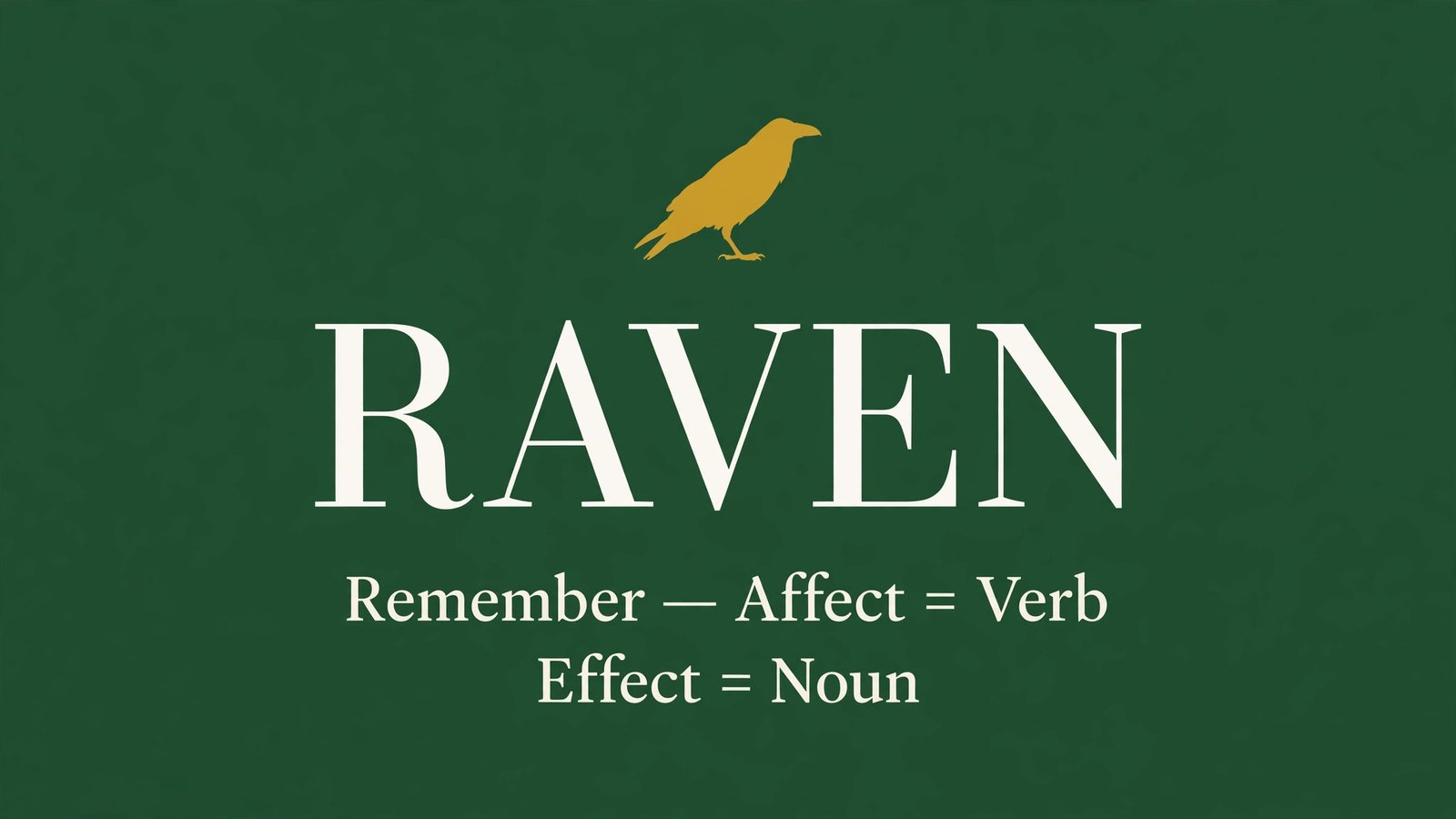
The best-known way to remember the difference is the RAVEN trick. RAVEN stands for Remember Affect = Verb, Effect = Noun. Picture a raven — the big black bird — and the word sticks in your mind. Say it three times — “Affect is a verb, effect is a noun” — and you will hear it in your head the next time you write.
Two more quick checks work just as well:
- The “the” test. If you can put “the” before the word, use effect. “The effect of the news was huge” works, because effect is a noun and “the” goes before nouns. “The affect of the news” sounds wrong — and it is.
- The alphabet test. A comes before E in the alphabet, and the action comes before the result. Affect (the action) happens first; effect (the result) comes after. Cause, then effect — in that order, every time.
Keep the RAVEN image in your mind and the choice becomes automatic. Most people only need to use the trick a few times before they stop needing it at all. After a week of noticing affect and effect in what you read, the right word will start to choose itself.
Common Mistakes to Avoid
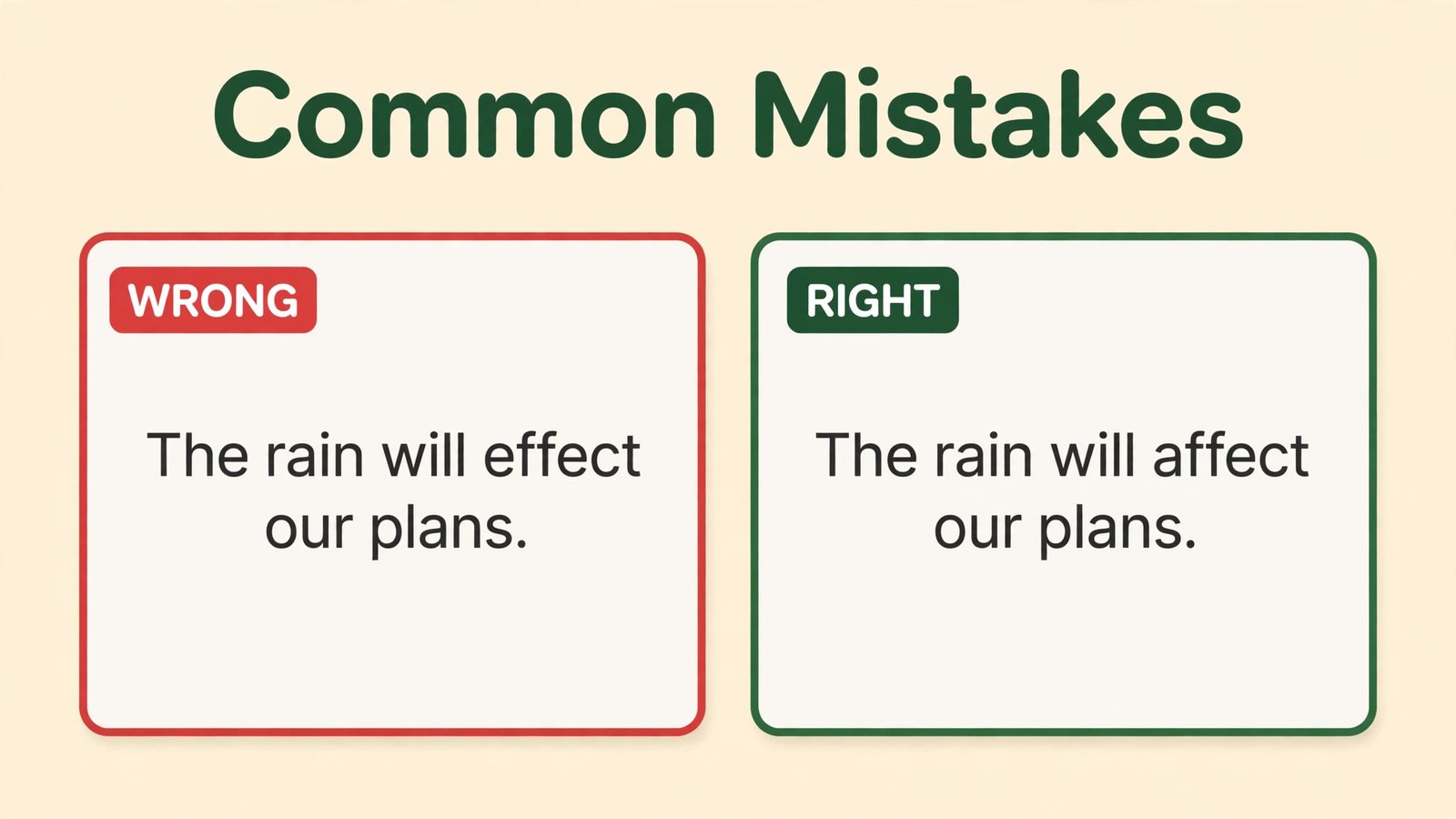
Even people who know the rule slip up in four places. Here they are, so you can spot them before they reach the page.
1. Using “effect” when you mean “affect”
This is the most common mistake of all. “The delay will effect our schedule” is wrong — the delay is influencing the schedule, so it must be “The delay will affect our schedule.” The same goes for “How will this effect me?” — it should be “How will this affect me?” Whenever something is acting on something else, reach for affect.
2. Thinking “effect change” is always wrong
Here is the twist: “effect change” is actually correct — but it means something different. As a verb, effect means to bring about or to cause something to happen. It is formal, and you will mostly meet it in business, politics and law. “The new manager hopes to effect real change in the company” means she hopes to bring about change. “The new manager hopes to affect change” means something else entirely: she hopes to influence a change that is already happening.
So both phrases are correct — they just say different things. Other formal uses of effect as a verb include “to effect a repair” (to carry out a repair), “to effect an escape” (to manage an escape) and “to effect a payment” (to make a payment happen). If you mean “bring about”, effect is the right verb. If you mean “influence”, it is affect.
3. Forgetting that “affect” can be a noun
In psychology, affect is a noun meaning a person’s visible emotional expression — the feelings you can see on someone’s face or hear in their voice. A doctor might write about a patient’s “flat affect” (very little visible emotion) or “blunted affect” (emotions that seem dulled). You will almost never need this meaning outside psychology or medicine, but it is worth knowing so that it never confuses you: the everyday rule — affect is the verb, effect is the noun — still holds everywhere else.
4. Mixing up “affected” and “effected”
The affected vs effected pair causes trouble because the past forms look so similar. Affected means influenced: “The workers were deeply affected by the pay cut.” Effected means brought about: “The committee effected the new rules” — that is, it put the new rules into force. Effected is rare and formal, so if you are unsure, use “affected” or rephrase with “brought about” or “put into effect”. “The committee brought about the new rules” says the same thing in plain English.
Affect and effect are not the only pair that causes trouble. Their, there and they’re confuse just as many writers — our guide to their, there and they’re sorts out that trio the same way.
Practice: Affect or Effect?
Now it is your turn. Choose affect or effect for each sentence, then check your answers below. Cover the answers while you work — the quiz only helps if you try first.
- The bad weather will ___ our picnic plans.
- The new medicine had a positive ___ on her health.
- The film deeply ___ everyone in the audience.
- The new rules will take ___ from Monday.
- The manager hopes to ___ real change in the company.
- Her calm voice had a soothing ___ on the children.
- How did the price rise ___ your holiday plans?
- The doctor noted the patient’s flat ___.
- The strike ___ thousands of commuters.
- The charity’s work has ___ the lives of many families.
Answers
- Affect — the weather is influencing the plans.
- Effect — a result you can name; “a positive effect” is a noun phrase.
- Affected — the film influenced the audience (past tense verb).
- Effect — the fixed phrase is “take effect”.
- Effect — here it means “bring about” real change (the formal verb).
- Effect — “a soothing effect” names the result of her voice.
- Affect — the price rise is acting on the plans; try “influence” and it fits.
- Affect — the psychology noun: the patient’s visible emotion.
- Affected — the strike influenced the commuters (past tense verb).
- Affected — the charity’s work influenced lives; “effected” would mean it created the lives, which makes no sense here.
How did you do? Eight or more correct means you have the rule. Fewer than that means the RAVEN trick deserves one more read — then try the quiz again tomorrow.
Frequently Asked Questions
Is it “effect change” or “affect change”?
Both are correct, but they mean different things. “Effect change” means to bring about change — to make it happen. “The committee effected change” means the committee made the change happen. “Affect change” means to influence a change that is already happening. “The new law affected the change in behaviour” means the law influenced a change that was already under way. In most everyday writing you want “affect”, because you usually mean “influence”. Save “effect change” for formal writing where you genuinely mean “bring about”.
Can effect be a verb?
Yes. As a verb, effect means to bring about or to cause something to happen. “The government effected major reforms” means the government brought the reforms about. It is formal and much less common than effect the noun, which is why most style guides tell you to use it carefully. In everyday writing, “bring about”, “carry out” or “put into effect” usually sound more natural.
Can affect be a noun?
Yes — affect as a noun exists, but almost only in psychology. There, “affect” is a noun meaning a person’s outward emotional expression — what you can see on their face or hear in their voice. “Flat affect” and “blunted affect” describe someone showing very little emotion. Outside psychology and medicine, you can safely treat affect as a verb and nothing else.
How do I use affect vs effect in a sentence?
Use affect when something does something to something else: “The rain affected our plans.” Use effect when you are naming a result: “The rain had an effect on our plans.” The two sentences say the same thing in different ways — one with the verb, one with the noun. If you can replace the word with “influence”, use affect. If you can put “the” in front of it, use effect.
What is the difference between affected and effected?
Affected means influenced: “She was deeply affected by the news.” Effected means brought about: “The board effected the merger.” Effected is rare and formal, and most readers will stumble over it, so use it only when you are sure of the meaning — or rephrase. “The board brought about the merger” is clearer for everyone.
Conclusion
Affect and effect are only one letter apart, but they do two different jobs. Affect is the verb — the action that influences something. Effect is the noun — the result that follows. Remember RAVEN (Remember Affect = Verb, Effect = Noun), try the “the” test when you are unsure, and give yourself a week of noticing the pair in everything you read. The choice will soon feel automatic.
Two things to keep in mind. First, the exceptions are real but rare: effect can be a verb meaning “to bring about”, and affect can be a noun in psychology. Knowing they exist stops them from ever confusing you. Second, good writing is not about memorising rules — it is about making the reader’s job easy. Choosing the right word is a kindness to your readers.
If this guide helped, keep going. Punctuation can change meaning just as much as word choice — our comma rules guide shows how a single comma can save (or wreck) a sentence. And if tenses still slow you down, the Present Perfect vs Past Simple guide is the next one to read. Master one pair at a time, and clear, confident English follows.

Daniel Harper is a former English teacher who now edits grammar guides for GrammarRoot. He writes clear, practical explanations with everyday examples, and checks every guide for accuracy before it is published.